How are calculation rules structured?
In PPM, you can use calculation rules to also create user-defined measures based on existing measures. To create a user-defined measure, define a calculation rule that determines how the measure value is calculated. By default, the arithmetic mean is used for each measure as a value for calculation.
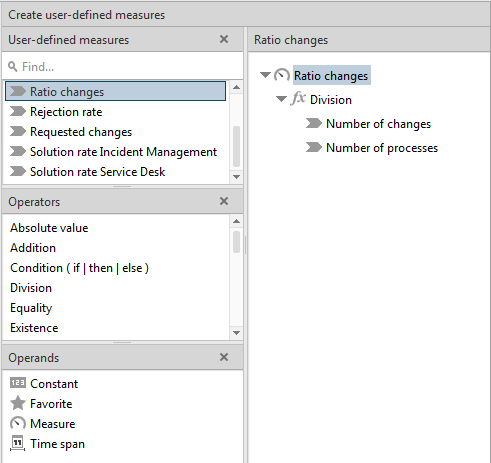
The calculation tree is the graphic representation of a formal calculation rule. The top node (base node) determines the basic properties of the measure calculated. For example, it indicates the name and data type and assigns the measure to a particular relation or a process type. At various levels, the nodes are followed by operators and operands that are hierarchically linked with each other. The hierarchy affects the sequence in which the operators are processed. The calculation is performed according to a depth-first search.
Whether you can insert an additional node at a point depends on your calculation rule. For example, if you have already inserted two nodes under the Division operator, you cannot insert any more nodes.
In this example, the user-defined measure Change rate (ratio changes) is calculated based on the ratio between number of changes and number of processes.