How time range dimensions work
With time range dimensions, you can log time ranges of different process states. This means, you log the time from when a process enters a certain status or phase to the time when this status or phase ends.
You can use the dimension type if you want to find out if and how long your process instances were in particular process states (for example, late goods issue, open invoices, being in process, etc.), and also when a process instance passed through these states.
Time range dimension vs. Time dimension
Time dimensions are always based on a current time stamp (for example, start time of a process, start time of a function) and can therefore reflect only the start or end of an activity or status, or illustrate the current state which can, however, change after each import.
Time range dimensions are based on two time stamps (start time and end time) and thus describe a time range during which a process has a certain state. Depending on the configuration of the client, different variants of time range dimensions are available.
Time range dimension variants
To handle different use cases three variants are available for configuring a time range dimension.
Time range dimension based on start time
Enables you to identify relevant process instances whose start time is of interest, for example, for identifying all overdue goods issue at the beginning of a week, month, or quarter.
Time range dimension based on end time
Enables you to identify relevant process instances whose end time is of interest, for example, for identifying all overdue goods issue at the end of a week, month, or quarter.
Time range dimension based on an interval
Enables you to identify relevant process instances whose entire queried interval is of interest, for example, for identifying all overdue goods issue in January, February, or the fourth quarter.
With the variant, you specify how the dimension value is to be evaluated in terms of filters and iteration step. With start time related and end time related time range dimensions, points of time (start or end time) are analyzed within an iteration interval or filter interval, and a process is deemed relevant if the respective analysis time lies within its dimension value (period).
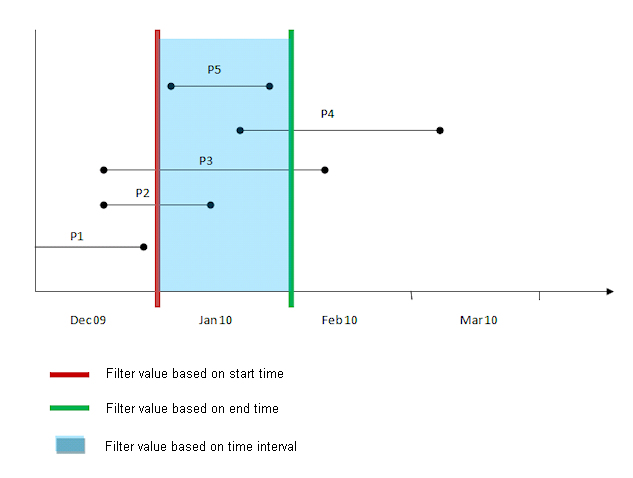
For the query "How many goods issued were late in January 2010?", the following results apply for the process instances (P1-P5) displayed in the graphic for the different variants:
Time range dimension based on start time: All process instances are included whose dimension value (time range) contains the point in time 01/01/10 12:00:00 AM: P2, P3
Time range dimension based on end time: All process instances are included whose dimension value (time range) contains the point in time 31/01/10 11:59:59 PM: P3, P4
Time range dimension based on an interval: All process instances are included whose dimension value (time range) has anything to do with January 2010: P2, P3, P4, P5