What ABC classification strategies exist?
With ABC classifications you can group the individual values of a dimension with regard to a particular numerical measure.
When creating your ABC classifications, you can follow these strategies:
Classification with regard to absolute measure values
Classification with regard to the cumulated measure value
Classification with regard to the total of the dimension values
Absolute measure values
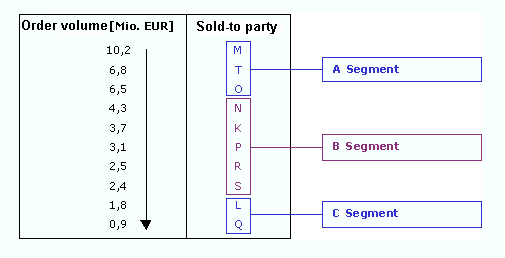
The classification relates to absolute measure values. The limits between the A and B segments and the B and C segments are predefined. The dimension values are assigned to the three groups in line with these limits.
You are creating an ABC classification for your customers (Sold-to party dimension) with regard to the sales generated (Order volume measure). You define the following classification limits:
A-B limit = 5 million EUR and B-C limit = 2 million EUR
Segment A contains all customers that generate sales greater than or equal to EUR 5 million. Segment B contains all customers that generate sales less than EUR 5 million and greater than or equal to EUR 2 million. Segment C contains all customers that generate sales less than EUR 2 million.
Percentage share of total measure value (Lorenz curve)
The classification relates to the cumulated measure value. This figure is 100%. The dimension values are sorted and assigned to the three groups according to the relevant value of the selected measure. The dimension values assigned to the A, B, or C segment should each add up to a particular percentage share of the total value of the measure.
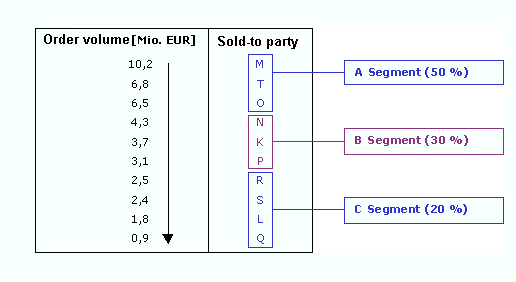
For example, if you specify the segmentation A = 50%, B = 30% and C = 20%, the dimension values are classified as follows: The A segment contains the dimension values with the best measure values, which add up to 50% of the cumulated measure value. The best measure value can be the highest or the lowest value depending on the selected measure. The B segment contains the dimension values, whose measure values add up to the next 30% of the cumulated measure value. The C segment contains the remaining 20% of the dimension values.
You are creating an ABC classification for your customers (Sold-to party dimension) with regard to the sales generated (Order volume measure). You define the following segmentations:
A = 50%, B = 30%, and C = 20%
The customers are sorted internally by the value of the Order volume measure. Segment A contains the customers who between them generate 50% of your company's sales. Segment B contains the customers who between them generate the next 30% of sales. Segment C contains the customers who in total generate the remaining 20% of sales.
Percentage share of the total number of dimension values
This classification relates to the total of the dimension values. This figure is 100%. The dimension values are sorted and assigned to the three groups according to the relevant value of the selected measure. The number of dimension values assigned to the A, B or C segments should each add up to a particular percentage share of the total number of dimension values.
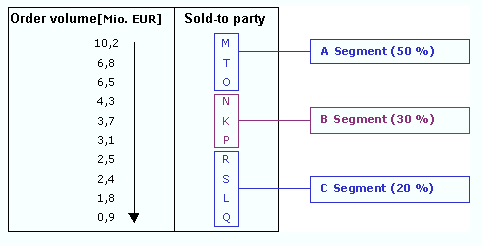
For example, if you specify the segmentation A = 50%, B = 30% and C = 20%, the dimension values are classified as follows: The A segment contains the 50% of dimension value with the best measure values. The best measure value can be the highest or the lowest value depending on the selected measure. The B segment contains the next 30% of dimension values and the C segment contains the remaining 20% of the dimension values.
You are creating an ABC classification for your customers (Sold-to party dimension) with regard to the sales generated (Order volume measure). You define the following segmentations:
A = 50%, B = 30%, and C = 20%
The customers are sorted internally by the value of the Order volume measure. Segment A contains the first 50% of customers with the highest measure value. Segment B contains the next 30% of customers. Segment C contains the remaining 20 % of customers.